It’s a submarine

Over on the Warhammer Community site there was a nice news item about a new diorama at Warhammer World, ‘The Battle for Grendel’s Lock’, an Armageddon themed display.

I’ll cut to the chase, yes there’s an Ork submarine model in the display.

I’ve always liked the idea of an Ork submarine, but have never got round to building one.

More on how the display came together.

Back in 2008 Games Workshop did publish a data sheet for an Ork Submersible (submarine) for Apocalypse. A few years later in 2011, Games Workshop Bristol built a submarine using parts from the Ork Stompa and the Bastion which looked very effective.

Over the last few years it has felt that Games Workshop moved away from scratch built models or conversions, sticking to the actual kits they sold. You did see the occasional foray into conversions in some of the displays at Warhammer World, but most of the time the painted models you saw on the website and in White Dwarf were essentially the same models you could buy from warhammer.com or your local shop. This submarine makes a nice change from the usual models, and there have been other conversions and scratch builds in recent issues of White Dwarf too.

Has it inspired me to think about scratch building my own submarine, yes it has. 

Sons of Horus Cerberus Heavy Tank Destroyer at Warhammer World

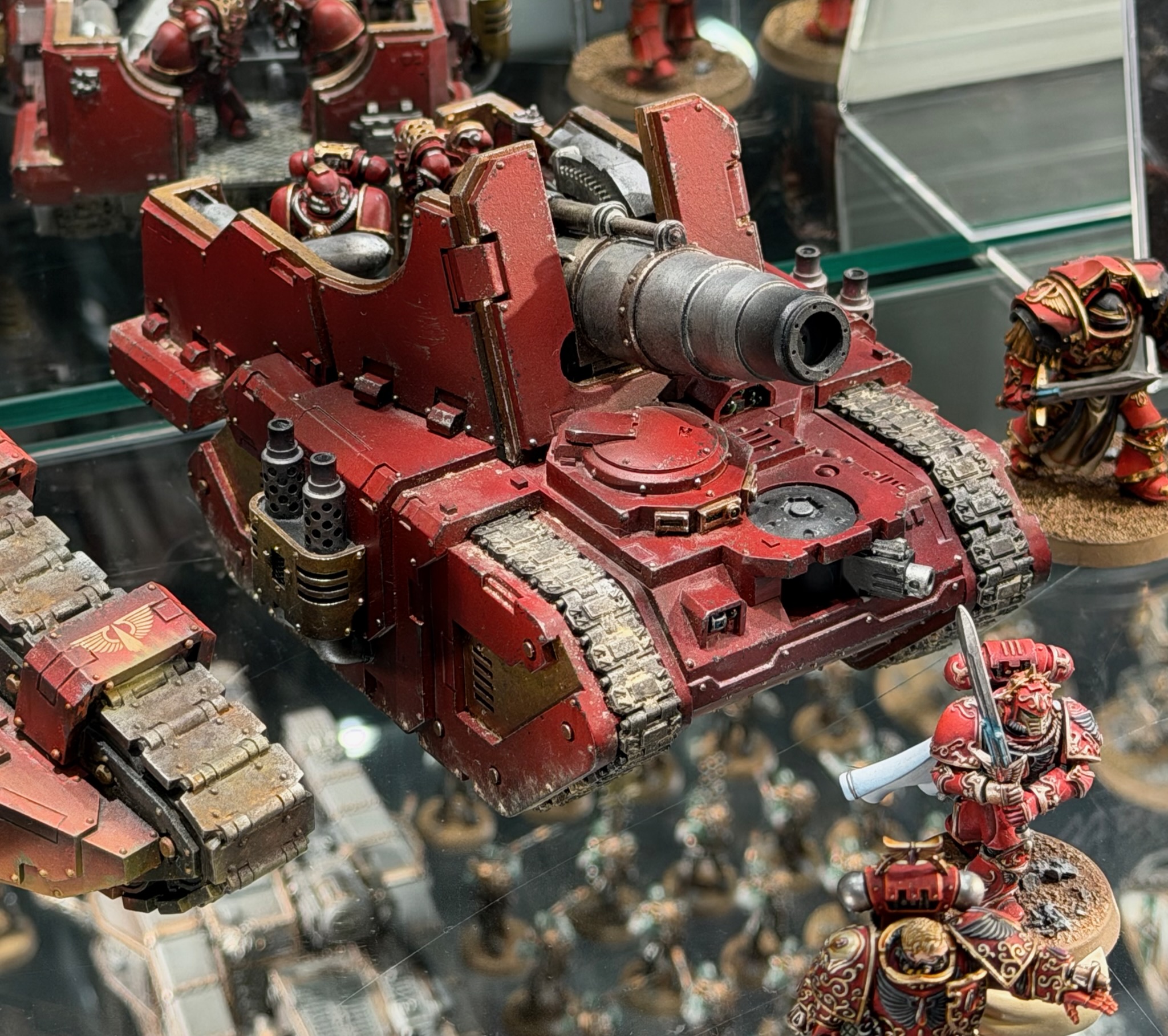
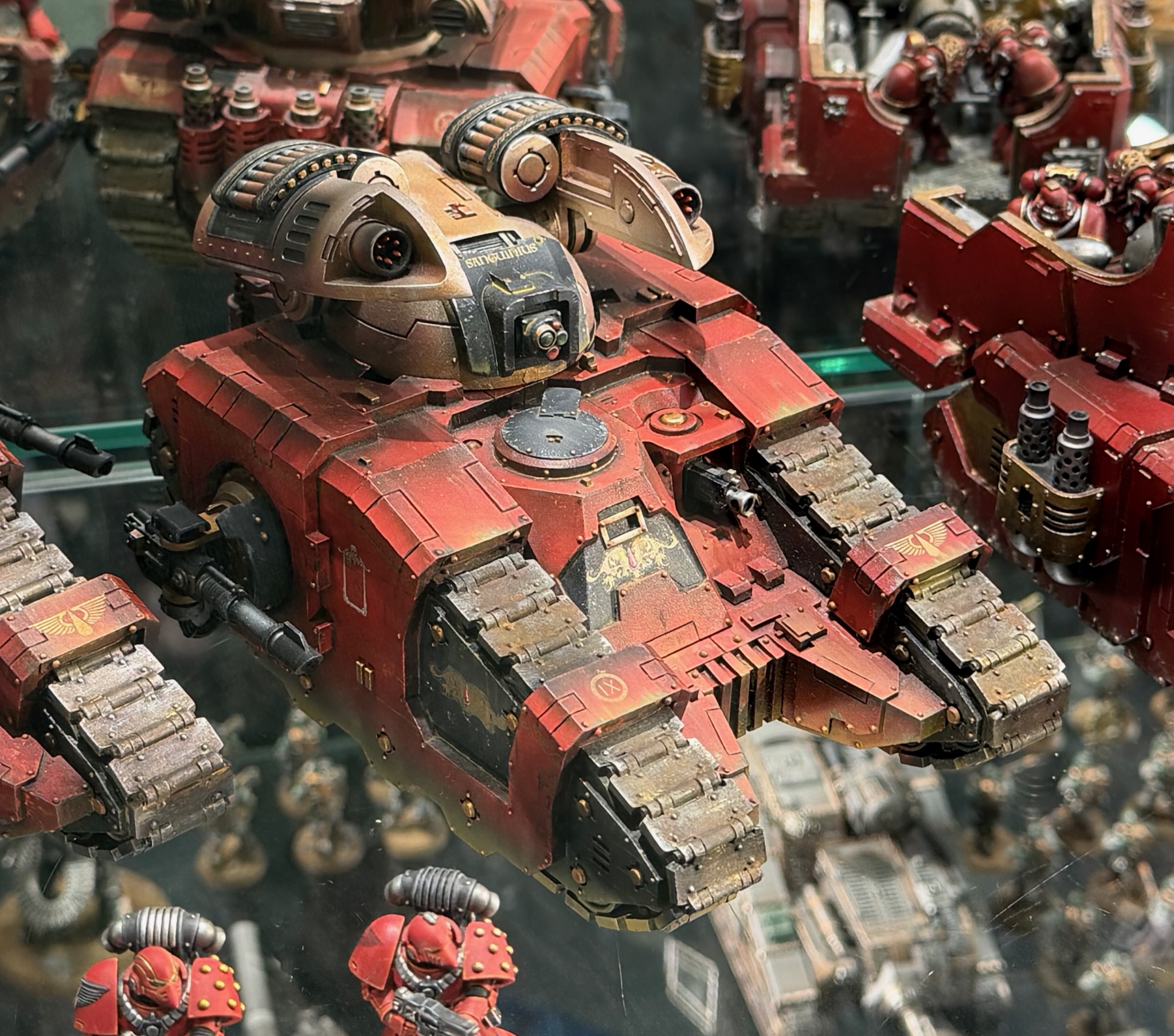
This Cerberus Heavy Tank Destroyer was on display at Warhammer World.

The Cerberus Heavy Tank Destroyer is a fearsome and highly specialised variant of the venerable Spartan chassis, developed during the Great Crusade and unleashed upon the galaxy by the Legiones Astartes. While it sacrifices the Spartan’s substantial transport capacity, its massive hull is uniquely adapted to house the complex apparatus required for its devastating primary armament: a prototype Neutron Laser Projector (often a triple-barreled configuration known as a Neutron Laser Battery).

The Neutron Laser is a weapon of the Dark Age of Technology, its principles still only poorly understood by the techno-savants of the Mechanicum. To manage the immense energies and deadly output, the Cerberus’s hull is crammed with sizeable arc-reactors and heavy radiation shielding. The weapon stands as one of the most effective anti-tank systems available to the Space Marine Legions.

This is the plastic kit for The Horus Heresy. The original resin kit was announced back in 2012 at Games Day.

Terracotta Cathayan Grand Cannons

When I made a trip to Warhammer World in June 2025 I was pleased to see the then new models for the Army of Grand Cathay for Warhammer Old World on display. I really liked the Cathayan Sentinel especially the paint job which made it look like it was terracotta. I also saw a posting on the Warhammer Community site about where Lewis from the Warhammer Studio had painted some Jade Warriors as terracotta warriors.

I started thinking about creating and painting a whole army in this style, so I bought a Cathayan Sentinel and the Grand Cathay Battalion.

I started constructing the Jade Warriors. After finishing some of those models I started on the Grand Cannon.

Cast in the likeness of roaring dragons, the Grand Cannons of Cathay unleash torrents of flame and iron upon the foe.  Whether saturating a wide front or concentrating their explosive power into a single, devastating projectile for sieges, they remain a cornerstone of Cathayan might.

First models to be made were the crew.

These were a lot easier to construct than the warriors.

I have been thinking about how I will paint the Grand Cannon. The human crew will be terracotta like the Jade Warriors. I think I will also need to reflect on how to paint the Ogre Loaders, who are mercenaries. First thoughts are to paint them as terracotta too. As for the cannon itself, that I think will be more brass than clay. I think a cannon made out of terracotta would explode upon firing. I have also gone down the cannon route rather than the Fire Rain Rocket Battery option.

Next step will be to make some more models.

Land Raider Spartan Assault Tank at Warhammer World

These are various Land Raider Spartan Assault Tanks that were on display at Warhammer World.

The Spartan Assault Tank, often referred to as the Land Raider Spartan, is a formidable armoured vehicle designed to breach the most impenetrable enemy defences and deliver devastating blows with its payload of Legion Astartes infantry. Its nigh-impervious hull, capable of shrugging off even the most potent anti-tank weaponry, makes it a truly formidable war machine. During the Great Crusade, the Spartan became an indispensable asset for the Legion Astartes. Its immense firepower and exceptional durability allowed it to lead the charge into the heart of enemy territory, paving the way for Legionaries to storm enemy fortifications. With a capacity to transport up to 26 Legionaries or 13 Terminators, the Spartan provided a mobile, armoured fortress that could be deployed rapidly to any sector of the battlefield. Despite its massive size, the Spartan possesses a surprising degree of agility, enabling it to manoeuvre effectively in tight spaces and avoid enemy fire. Its combination of speed, firepower, and protection makes it a truly versatile and devastating weapon, capable of turning the tide of battle in favour of the Legion Astartes forces using it.

More photographs of the Land Raider Spartan Assault Tank.

The Battle of Matorea at Warhammer World

The Warhammer Old World diorama, “The Battle of Matorea,” is a breathtaking tableau that vividly brings to life a dramatic clash between the chivalrous Bretonnian Knights and the ancient, undead legions of the Tomb Kings of Khemri. This expertly crafted scene captures a pivotal moment in what must have been a desperate struggle, highlighting the contrasting aesthetics and fighting styles of these two iconic factions.

Settra the Imperishable lays siege to the coastal city of Matorea with a massive undead host as Cecil Gastonne, the Wyrm Slayer rallies its hopelessly outnumbered defenders. Just as the city’s defences begin to fail, the trumpeting of silver clarions sounds in the east, heralding the arrival of Duke Gastille. Have the duke and his knights arrived in time to lift the siege, or will they join the doomed defenders in a heroic death?

At the heart of the diorama, the Bretonnian Knights, resplendent in their vibrant heraldry and polished plate armor, are depicted mid-charge, lances lowered and banners flying high. The dynamism of their assault is palpable, conveying the sheer force and faith with which these champions of the Lady throw themselves into battle. One can almost hear the thundering hooves and the shouts of “For the Lady!” as they aim to shatter the brittle ranks of their skeletal foes. The diorama likely showcases various knightly orders, perhaps even a Duke or a Grail Knight, leading the charge with unwavering determination, their mounts rearing or galloping furiously into the fray.

Opposing this glorious charge, the Tomb Kings of Khemri present a stark and unsettling contrast. Their skeletal warriors, ancient and unfeeling, form an unyielding tide of bone and rusted bronze. Hierophants and Tomb Princes, perhaps astride macabre chariots or mighty constructs like Ushabti, would be strategically positioned, directing their automaton armies with an eerie, silent resolve. The diorama would no doubt emphasize the sheer numbers of the Tomb Kings, with ranks of skeleton warriors, archers, and perhaps even animated constructs like Screaming Skull Catapults or Necrolith Colossi, adding to the sense of overwhelming, relentless pressure. The bleached bones and dusty, tattered banners of Khemri create an atmosphere of dread and ancient power, starkly contrasting with the vibrant colours of Bretonnia.

“The Battle of Matorea” isn’t just a collection of miniatures; it’s a narrative frozen in time. The composition likely draws the viewer’s eye to key points of conflict – a Bretonnian Knight’s lance impaling a skeletal champion, a Foot Knight desperately defending a standard against a tide of mummified horrors, or a magical duel between a Bretonnian Damsel and a Liche Priest. Through meticulous detail and expert painting, the diorama effectively conveys the chaos, heroism, and horror of war in the Old World, making it a truly immersive and captivating piece for any Warhammer enthusiast. It serves as a testament to the rich lore and enduring appeal of the setting, particularly the epic conflicts that define its factions.

More photographs of The Battle of Matorea.

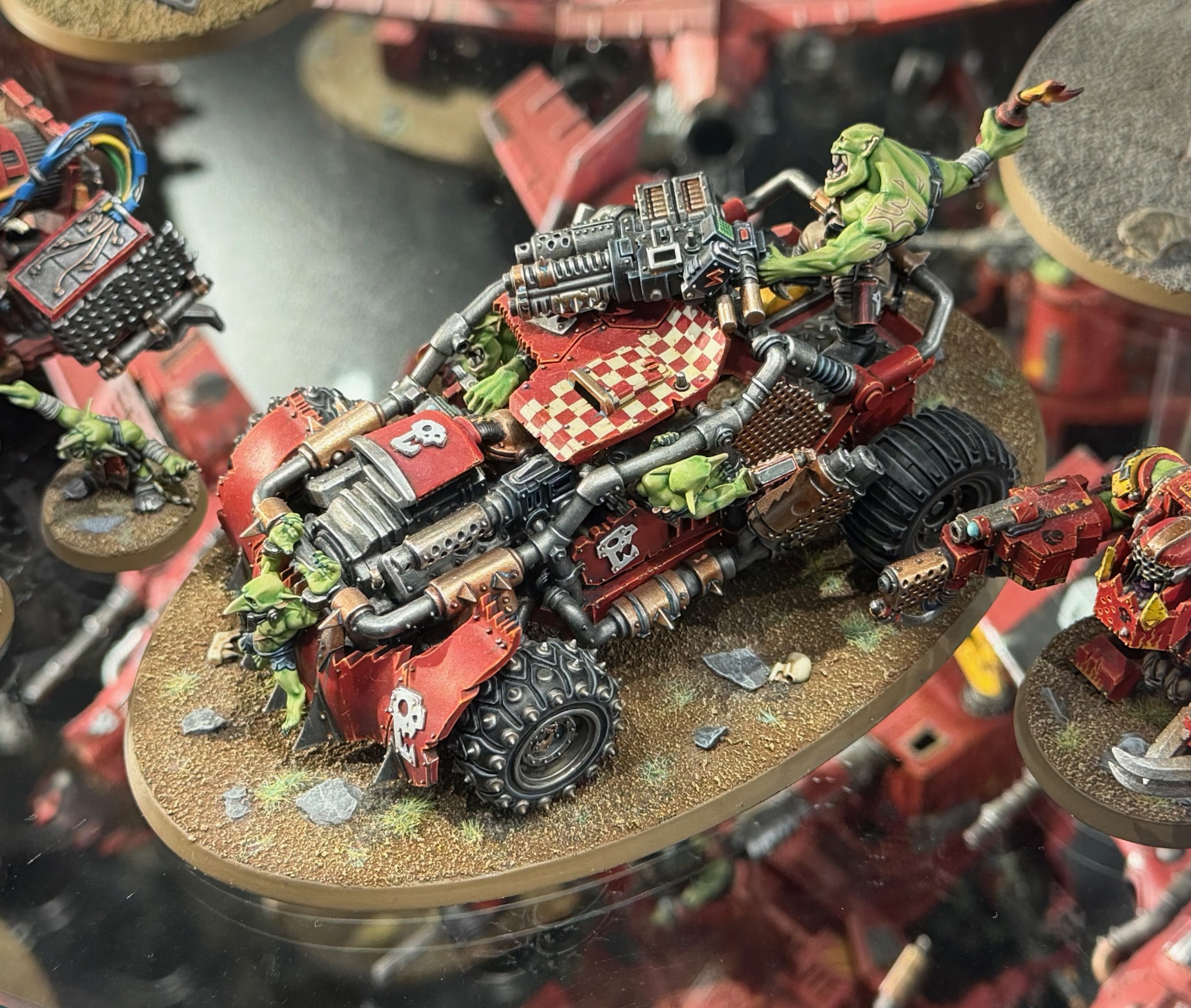
Ork Battlewagon

A Battlewagon is a catch-all term used for any type of Ork assault tank and heavy armoured troop transport. The term Battlewagon seems to refer overall to a category of large Ork armoured vehicles. A Battlewagon can be wheeled, tracked or a combination of the two and is used in many battlefield roles. It always carries a large complement of weapons.

Sometimes these armaments are just Big Shootas, while on other vehicles they are large Killkannons. Battlewagons possess thick armour plating, multiple turrets and death rollers or rams. They also carry mobs of Ork Boyz, either internally or clinging onto its many handholds.

Photographs from Warhammer World.

More photographs of Ork Battlewagons.

Workbench feature on one of my Battlewagons.

The Dropsite Massacre

Within the Urgall Depression, the Salamanders fall back from their faltering attack on the Warmaster’s fortress, expecting the newly arrived Second Wave to bolster the assault and finally break Horus’ defences. Instead, Vulkan’s warriors unknowingly turn back towards their annihilation – the guns of the Iron Warriors arrayed against them in betrayal. Their presumed allies unleash a ruthless barrage of fire into the Salamanders’ lines, turning the black sands into a mire soaked with Nocturnean blood.

Originally planning to show the pivotal moment of the betrayal, the Warhammer World Studio instead decided to set this diorama late in the battle in order to convey the absolute devastation caused. Panels of trackway, providing access to rapidly deployed emplacements, were built to reflect the Iron Warriors expertise at engineering and siege warfare.

Over a thousand casualties were created for this diorama. One set was converted in a range of static poses, and cast in resin. A second set, with only bodies and legs were also assembled, then moulds made and hundreds cast in resin, before individually adding the arms, heads anc backpacks in different poses.

Orc Boar Boyz

These Orc Boar Boyz were on display at Warhammer World.

Orc Boar Boyz

Orc Boar Boyz represent the devastating, bad-tempered shock cavalry of the Orc & Goblin Tribes. Riding into battle atop ferocious War Boars—beasts so foul-tempered and thick-skulled that they are just as likely to gore an enemy as the Orc riding them is to hack them apart—these heavy cavalry units excel at breaking enemy lines through sheer brute force. A well-timed charge from these heavily armoured green skins can easily trample the disciplined infantry blocks of the Old World into the mud.

Ironhead Squat Prospectors Skalvian Explorator

Built to withstand the brutal expanse of the Great Equatorial Wastes, the Skalvian Explorator is a testament to Ironhead Squat engineering. Part heavy-duty excavator, part armored fortress, this all-terrain behemoth excels at tearing wealth from the ash wastes and hauling it back alive. While the Squats are legendary gunsmiths, the Explorator proves that when you wrap heavy mining machinery in thick enough armor, you get a vehicle that can trade blows with the deadliest war machines Necromunda has to offer.

More photographs of the Ironhead Squat Prospectors Skalvian Explorator.